

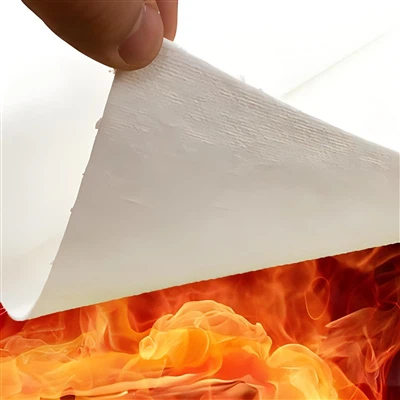
Zhejiang Runhui New Materials Co., Ltd.
Zhejiang Runhui New Materials Co., Ltd., based in Shengzhou, Zhejiang Province, has emerged as a defining force in advanced insulation solutions, with a laser focus on addressing the extreme demands of liquefied natural gas (LNG) transportation. Since its founding, the company has invested heavily in bridging nanotechnology and industrial application, assembling a team of materials scientists, engineers, and maritime experts to refine aerogel-based insulation.
Runhui's commitment to innovation is evident in its R&D ecosystem: partnerships with academic institutions specializing in nanomaterials, in-house testing facilities simulating maritime conditions (from polar cold to tropical humidity), and a production line optimized for consistency. At the heart of this effort is the Aerogel Blanket-a material born from the company's expertise in stabilizing aerogel within fibrous matrices. By refining the manufacturing process to eliminate defects in the nanoporous structure and enhance fiber-aerogel bonding, Runhui has created a product that meets and exceeds the stringent requirements of LNG carriers. This dedication has made the company a trusted partner for global maritime stakeholders, from shipyards constructing next-gen carriers to energy firms expanding their LNG fleets.
The Critical Need For Advanced Insulation In LNG Carriers
LNG carriers are vital cogs in the global energy infrastructure, enabling the transport of natural gas across oceans to meet growing demand for cleaner fuels. Their operation hinges on maintaining LNG at -162°C, a temperature that allows efficient storage but leaves no margin for error: even trace heat ingress can destabilize the cargo.
Beyond the technical risks, inefficient insulation carries significant economic consequences. Boil-off gas (BOG) from heat-induced vaporization represents lost revenue-each ton of BOG vented or re-liquefied cuts into profitability. For large carriers, which can hold 170,000+ cubic meters of LNG, even a 1% increase in BOG rates translates to substantial financial losses over a vessel's lifespan. Excessive heat ingress forces carriers to consume more fuel for re-liquefaction systems, raising operational costs and carbon emissions.
This dual pressure-technical and economic-has intensified the search for insulation that can perform reliably across the diverse conditions LNG carriers encounter: from the icy waters of the Northern Sea Route, where external temperatures plummet, to the warm currents of the South China Sea, where ambient heat and humidity test material limits. Traditional insulators, designed for static or less extreme environments, simply cannot adapt, making aerogel-based solutions.
Runhui's Aerogel Blanket
Aerogel's unique structure-nanoscale pores trapping air-gives it unmatched thermal resistance, but harnessing this in a form suitable for industrial use requires precision engineering. Runhui's Aerogel Blanket achieves this by embedding aerogel in a matrix of high-strength fibers, a process refined through years of iteration.
The manufacturing process prioritizes uniformity: strict control over aerogel particle size, fiber distribution, and coating application ensures that each batch performs consistently. Quality checks to extreme thermal cycles (from -196°C to 60°C) and mechanical stress tests (vibration, compression) to mimic maritime conditions. This rigor results in a material that retains its properties even after prolonged use, a key advantage over traditional insulators that degrade gradually.
Notably, Runhui's hydrophobic coating is more than a protective layer: it is engineered to bond molecularly with the aerogel, preventing delamination-a common failure point in lesser hydrophobic insulators. This ensures long-term water resistance, critical for withstanding salt spray, condensation, or accidental water exposure during maintenance.


LNG Carrier-Specific Challenges
Enabling Arctic LNG routes: As melting sea ice opens new Arctic shipping lanes, LNG carriers face unprecedented cold. Runhui's Aerogel Blanket, tested in simulated polar conditions, maintains thermal efficiency at -50°C external temperatures, where traditional insulators often become brittle and lose performance. This reliability is pivotal for reducing BOG in regions where re-liquefaction capacity is limited.
Supporting larger vessel designs: Modern LNG carriers are growing in size to economies of scale, with some exceeding 200,000 cubic meters. Larger tanks mean more surface area for heat ingress; aerogel's thin profile allows insulation to scale without adding excessive weight, a critical factor in maintaining vessel buoyancy and fuel efficiency.
Simplifying installation and maintenance: Unlike rigid traditional insulators, Runhui's Aerogel Blanket is flexible and easy to cut, reducing installation time by up to 40%-a significant benefit for shipyards facing tight construction schedules. Its durability minimizes maintenance: inspections require no specialized tools, and damaged sections can be replaced without disrupting the entire insulation system.
Why Aerogel Blanket Outperforms Traditional Insulation
The gap between aerogel and traditional insulators widens in real-world operation. During a prolonged voyage through the Indian Ocean, where ambient temperatures hovered around 35°C, a carrier insulated with Runhui's Aerogel Blanket recorded 50% less BOG than a sister vessel using polyurethane foam. Over six months, this translated to reduced fuel consumption for re-liquefaction and fewer emissions.
In another case, a carrier navigating a tropical storm experienced saltwater intrusion into its insulation system. While the glass wool in non-critical areas degraded within weeks, the aerogel blanket in the tank walls remained intact, its hydrophobic coating preventing moisture absorption. This resilience avoided costly repairs and ensured cargo integrity.
Traditional materials struggle with thermal cycling: repeated expansion and contraction as the vessel moves between climate zones creates gaps in perlite or foam, compromising insulation. Aerogel's flexibility allows it to expand and contract without cracking, maintaining a continuous thermal barrier-a feature validated in long-term studies tracking insulation performance over thousands of nautical miles.
Notably, aerogel's superiority extends to lifecycle analysis. While upfront costs are higher, the Aerogel Blanket's 20+ year lifespan-double that of many traditional insulators-results in lower total cost of ownership. This is particularly impactful for LNG carriers, which operate for 25+ years and face rising maintenance costs with age.
Industry Adoption And Real-World Applications
The shift to aerogel in LNG carriers is not merely a trend but a reflection of evolving operational needs. Major shipyards now specify aerogel-based insulation for new builds, citing reduced lifecycle costs and enhanced safety. Energy companies, too, are retrofitting existing fleets: a European LNG operator recently announced plans to upgrade 10 vessels with Runhui's Aerogel Blanket, projecting a 15% reduction in BOG-related losses.
This adoption extends beyond deep-sea carriers to coastal LNG barges and floating storage units (FSUs), which operate in shallower waters and face frequent loading/unloading cycles. The blanket's durability under repeated thermal stress makes it ideal for these applications, where traditional insulators often fail prematurely. An FSU in the Gulf of Mexico, insulated with Runhui's Aerogel Blanket, maintained stable LNG temperatures through 50+ loading cycles, whereas a neighboring unit using expanded perlite required insulation repairs after 15 cycles.
Regulatory Alignment And Global Standards
Navigating the complex web of maritime regulations requires insulation that can meet diverse criteria, from fire safety to environmental impact. Runhui's Aerogel Blanket undergoes third-party testing to validate compliance with:
IMO FTP Code: Ensuring non-combustibility and low smoke emission during fire scenarios, a critical safety feature for vessels carrying flammable cargo.
ISO 16228: Setting benchmarks for thermal performance in cryogenic applications, ensuring the blanket meets global standards for LNG storage and transport.
Marine pollution regulations: Its inert composition and lack of toxic additives align with international rules restricting harmful substances in maritime equipment, reducing environmental risk in case of accidental damage.
While the absence of CE certification might seem a barrier, Runhui's comprehensive third-party validation has facilitated market access, demonstrating that performance and compliance can coexist without regional certifications.
Runhui's Role In Shaping The Future Of LNG Transport
As the LNG industry evolves, so too does the demand for smarter, more sustainable insulation. Runhui's R&D pipeline reflects this, with three key areas of focus:
Bio-based aerogel composites: Exploring renewable sources for aerogel production to reduce reliance on synthetic materials. Early prototypes maintain thermal performance while lowering the carbon footprint of manufacturing.
Integrated monitoring systems: Developing Aerogel Blankets with embedded fiber-optic sensors that measure temperature gradients in real time. This data, fed into the ship's management system, allows operators to detect heat ingress early, preventing BOG spikes and enabling targeted maintenance.
Circular economy practices: Designing the Aerogel Blanket for end-of-life recycling, with processes to recover silica and fibers for reuse in new insulation. This aligns with the maritime industry's push to reduce waste and extend material lifecycles.
Runhui is collaborating with naval architects to integrate aerogel insulation into hull designs, reducing overall vessel weight and improving hydrodynamic efficiency. Early simulations suggest this could lower fuel consumption by 3–5%-a significant contribution to the IMO's 2050 net-zero goals.
Aerogel Blanket As A Cornerstone Of Modern LNG Transportation
The reliance of LNG carriers on Aerogel Blanket is rooted in its unique ability to solve the industry's most pressing challenges: maintaining cryogenic temperatures across extreme environments, reducing operational costs, and enhancing safety. Zhejiang Runhui New Materials Co., Ltd.'s dedication to refining this technology-from material science to manufacturing precision-has positioned its Aerogel Blanket as an indispensable component of modern LNG transport.
As global energy systems transition toward lower-carbon fuels, LNG carriers will play an increasingly vital role, and their performance will depend on innovations. Runhui's commitment to advancing this technology ensures that it will remain at the forefront, enabling safer, more efficient, and more sustainable maritime energy transport for decades to come.
For stakeholders in the LNG value chain-from shipbuilders to energy producers-Aerogel Blanket is more than an insulation material: it is a catalyst for progress, unlocking new routes, larger vessels, and higher efficiency in a sector critical to the global energy transition.